
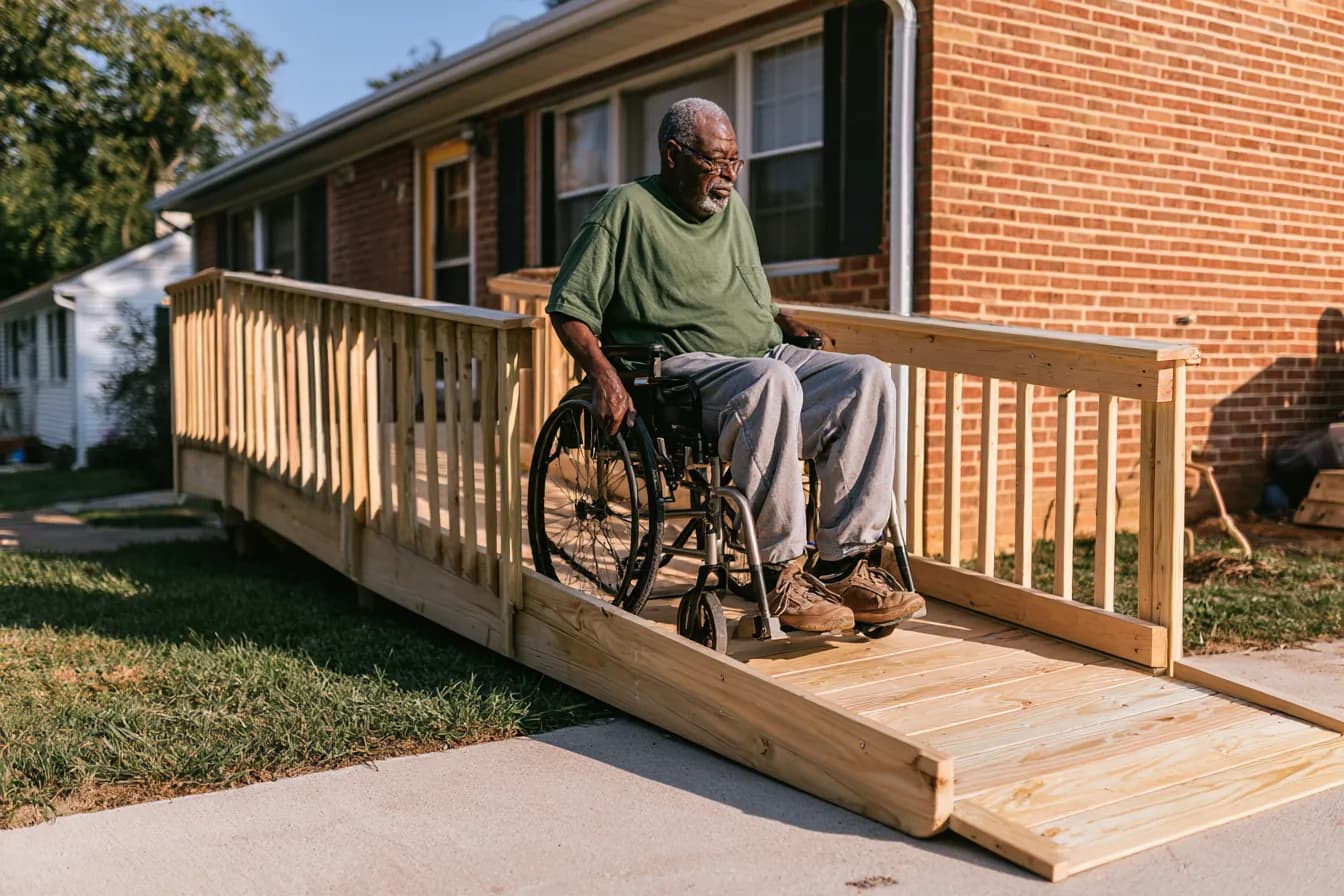
Why the entry matters so much
If you can't get in, nothing else in the house matters. The front door is also the way paramedics, a walker and a wheelchair all have to come. Plenty of houses around DC, Maryland and Northern Virginia have steps there, often a stoop with a rail on one side or none, and a heavy storm door that swings shut on whoever is holding it.
What we check at the door
On the assessment we stand at every door that gets used and go in and out the way your parent does. We check the steps and whether there's a rail to grab on both sides, the size of the landing, the threshold height, the weight of the door and its handle, and how well the steps are lit after dark. We also walk the path from the car or the sidewalk, because that's where the entry really starts.
How entries get fixed
Most entries start with railings on both sides of every step, lever handles in place of knobs, and lighting on the steps. Where steps are the barrier, a ramp comes next. Some ramps are built on site and some are modular, which matters if you rent or expect to move. Where the ground allows it, a zero-step entry removes the steps entirely. Thresholds can be lowered and doors widened when a walker or wheelchair is in the picture. A keypad lock means nobody has to manage keys with shaky hands, and family or a caregiver can get in when needed.
The report ranks all of this by danger, so a missing rail on a steep stoop gets fixed long before anything cosmetic.
When the entry has to be ready by a date
A discharge home or a parent moving in often comes with a fixed date. Modular ramps can be set up ahead of it and swapped for a permanent ramp later. Tell us the date on the first call.
Questions families ask
Can a ramp go in at a rental?
Often, yes. The landlord has to agree in writing, and we draft that letter. A modular ramp also leaves with you when you move out.
Is one railing enough?
For most people with weak balance it isn't. A rail on both sides lets someone hold on with the stronger hand going up and again coming down.
The fix
Rails on both sides, a ramp sized to the real rise and a door wide enough for the walker, lit well enough to see the last step. The work lives under wheelchair ramps and home access, with help from lighting and home safety.